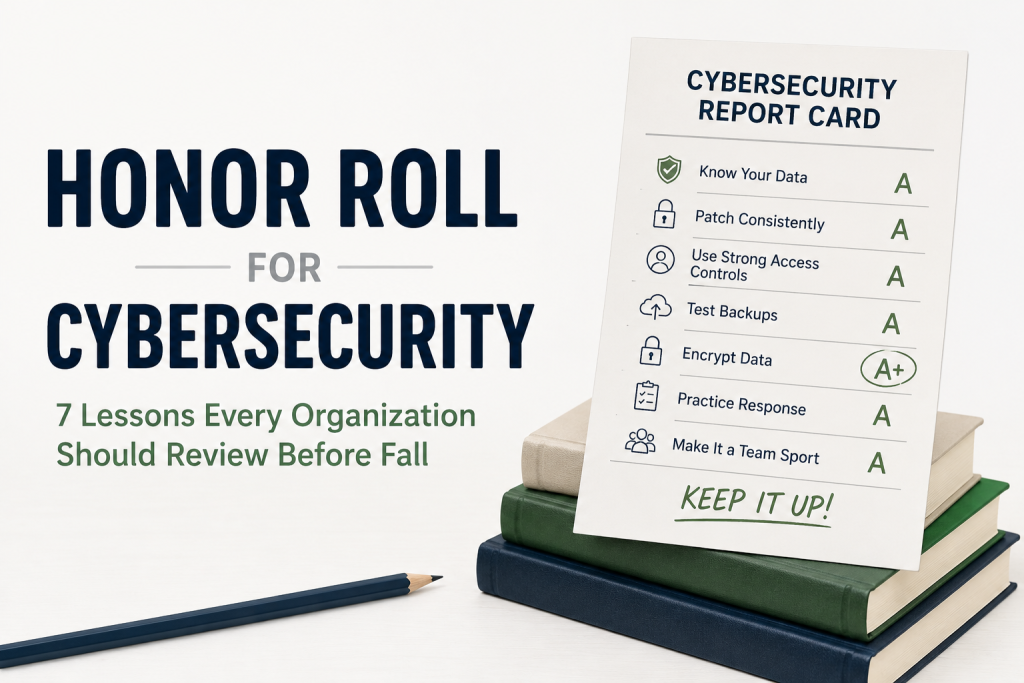
As students head back to school each August, they’re sharpening pencils, buying notebooks, and preparing for a new year of learning. Organizations should take the same approach to cybersecurity.
The threat landscape is constantly evolving, especially with AI accelerating the speed and sophistication of attacks, but the fundamentals of protecting data remain remarkably consistent. The companies that weather cyber incidents the best aren’t always the ones with the biggest budgets or the flashiest security tools. More often, they’re the ones that consistently earn high marks on the basics.
Consider this your cybersecurity report card.
Lesson #1: Know Where Your Sensitive Data Lives
You can’t protect what you can’t find. Many organizations have invested heavily in protecting networks, endpoints, and identities, yet still struggle to answer a surprisingly simple question: Where is our most sensitive data stored?
Customer records, financial information, intellectual property, healthcare data, employee records – these assets often exist in more places than IT realizes. Before investing in another security solution, take inventory. Data discovery and classification remain foundational to every effective cybersecurity strategy.
Grade Booster: If you don’t know where your data lives, you can’t adequately protect it.
Lesson #2: Patch Like the Test Is Tomorrow
Cybercriminals rarely need to invent new vulnerabilities. They simply exploit known ones before organizations get around to fixing them.
Delayed patching continues to be one of the easiest ways attackers gain access to systems. While no organization can patch everything immediately, maintaining a disciplined vulnerability management process dramatically reduces risk.
Security doesn’t require perfection. It requires consistency.
Lesson #3: Passwords Aren’t Enough Anymore
Passwords were never designed to withstand AI-powered phishing campaigns, credential stuffing, or automated attacks.
Layered security, such as multi-factor authentication (MFA), has become one of the simplest and most effective ways to reduce account compromise. Combined with strong password hygiene and identity management, it significantly raises the bar for attackers.
Think of MFA as locking both the front door and the deadbolt.
Lesson #4: Backups Are Essential but They’re Not the Finish Line
Every organization should have tested, reliable backups, but backups only answer one question:
“How do we recover?” They don’t answer: “What happens if our data is stolen before we recover?”
Modern ransomware groups increasingly steal data before encrypting systems, using extortion as leverage even when victims can restore from backups.
Recovery matters but preventing stolen data from becoming useful matters just as much.
Lesson #5: Encrypt the Data, Not Just the Network
For years, cybersecurity strategies focused primarily on threat detection and perimeter fortification. Today’s reality is different.
Organizations should assume that, at some point, an attacker will bypass preventive controls. When that happens, the question shifts from “how did they get in?” to “what can they actually do once they’re there?”
This is where data-at-rest encryption changes the conversation. Properly encrypted data remains unreadable and unusable without authorized access even if attackers manage to steal it. Instead of protecting only the perimeter, encryption protects what matters most: the data itself.
In many cases, that’s the difference between a costly breach and a security incident with limited impact.
Lesson #6: Practice Before the Real Exam
Schools conduct fire drills without expecting a fire. Organizations should treat cyber incidents the same way. Tabletop exercises, recovery testing, incident response planning, and clear communication protocols help teams respond calmly when an attack occurs. Waiting until ransomware strikes is the worst time to discover gaps in your response plan.
Preparation builds confidence long before it’s needed.
Lesson #7: Remember That Cybersecurity Is a Team Sport
Technology alone cannot solve cybersecurity. Employees remain both an organization’s greatest strength and one of its biggest risks. Regular awareness training, phishing simulations, and clear security policies help create a culture where everyone understands their role in protecting sensitive information.
Cybersecurity isn’t solely an IT responsibility. It’s an organizational mindset.
Final Grade
Every school year begins with a clean slate. Cybersecurity audits offer organizations that same opportunity. While AI continues to reshape both attacks and defenses, one lesson has remained remarkably consistent: protecting the data itself is one of the smartest investments any organization can make. Detection tools will continue to evolve. Threat intelligence will become faster. Automation will become smarter but if attackers can’t read your data, they can’t monetize it, extort you with it, or use it against you. Learn more about encryption in the age of AI from NetLib Security’s CTO, David Stonehill: “As AI continues to evolve, attacks will become more convincing, more automated, and harder to detect. But encryption, properly implemented, remains one of the few controls that doesn’t rely on predicting attacker behavior.”
That lesson deserves an A+ every year.
About NetLib Security
NetLib Security has spent the past 20+ years developing a powerful, patented solution that sets up a formidable offense for every environment where your data resides: physical, virtual and cloud. Our platform simplifies the process while ensuring high levels of security.
Simplify your data security needs. Encryptionizer is easy to deploy. It is a cost-effective way to proactively and transparently protect your sensitive data that allows you to quickly and confidently meet your security requirements. With budget considerations in mind, we have designed an affordable data security platform that protects, manages, and defends your data, while responding to the ever-changing compliance requirements.
Data breaches are expensive. Security does not have to be.
NetLib Security works with government agencies, healthcare organizations, small to large enterprises, financial services, credit card processors, distributors, and resellers to provide a flexible data security solution that meets their evolving needs. To learn more or request a free evaluation visit us at www.netlibsecurity.com.